Tuesday, 11 October 2016

About Villanelle by Paul Dukas


Some ideas about how to play Villanelle By Dukas


Algunos consejos sobre la Villanelle de Paul Dukas

About Natural Horn playing in the Brahms Horn Trio


Some advices about the Adagio mesto and how to play on the natural horn


                      Consejos sobre el adagio mesto en el trio de Brahms con la trompa natural

Saturday, 14 May 2016

Hommage a Brahms


"Hommage a Brahms"


Tomorrow Sunday 15th of May at 11´30, our concert with the Brahms and Ligeti trios, and also duo pieces (Kirchner and Brahms) will be broadcasted trough Radio Nacional de España, Radio 2. You can listen live to it everywhere in the world trough the Internet.
http://www.rtve.es/radio/radioclasica-endirecto/
Here you have also a small video from the concert as an appetizer


Mañana Domingo 15 de Mayo, será emitido en Radio 2 clásica, de Radio Nacional de España, a las 11.30h, para todos aquellos que no pudieron venir, nuestro concierto del día 9 de Mayo en el Auditorio Nacional de Madrid. Podéis oírlo en directo desde cualquier lugar del mundo por Internet en
http://www.rtve.es/radio/radioclasica-endirecto/
Podéis ver nuestro pequeño vídeo para abrir boca.


Monday, 7 March 2016

New review for Mozart CD in Internet


Mozart: Horn Concertos, Horn QuintetJavier Bonet (horn), Münchner Rudfunkorchester/Hermann/Baumann(Javier Bonet)
New releases of Mozart's horn concertos tend to go down the period instrument, unvalved route, with outstanding recent versions from Roger Montgomery andPip Eastop. This crowd-funded disc has Javier Bonet playing a modern horn, backed by an orchestra conducted by veteran hornist Hermann Baumann. Baumann himself recorded these concertos on both natural and valved horns, and here he proves to be sublimely affable accompanist. Bonet's bright, clear sound won't be to all tastes, but it serves his performance style beautifully; these are deliciously vocal performances. And scrupulously prepared, too. K417's first movement includes John Humphries' idiomatic reconstruction of the movement's close: what follows after the cadenza sounds noticeably more Mozartian than what we're used to. Bonet's account of the enigmatic D major concerto K412 features a more authentic version of the Rondo, almost derailed by a cheekily inauthentic cadenza.
This is a comprehensive set, the bonus features including Humphries' edition of the Eb Concert Rondo, a dazzling performance of the sublime Horn Quintet and a snatch of Bonet playing the natural horn. Especially poignant is the E major concerto fragment, stopping abruptly after a tutti flourish as promising as that which opens Mozart's Clarinet Concerto. All good, and horn aficionados fans will lap up the edition which includes a bonus 'Making Of' DVD. Bonet's balletic playing is entertaining to watch; it's refreshing to see musicians having such fun.


Thursday, 11 February 2016

Recital in La Palma / Recital en La Palma


CONCIERTO DE TROMPA Y PIANO / HORN AND PIANO RECITAL

JAVIER BONET - TROMPA
MIRIAM GÓMEZ-MORÁN - PIANO


Program


I

F. Schubert: La trucha 

W.A. Mozart: Andantino

F. Schubert: Impromptu op. 90 nº 2 (piano solo)

F. Strauss: Nocturno op. 7

M. Bruch: Kol Nidrei


II

R. Schumann: Adagio y allegro

F. Schubert: Impromptu op. 90 nº 4 (piano solo)

S. Rachmaninoff: Vocalise

F. Kreisler: Liebesleid

V. Monti: Csárdás

Friday, 11 December 2015

J. F. Gallay and how to sing on the natural horn

Singing on the horn. J.F Gallay, a great virtuoso of the natural horn!

A video speaking about Gallay and playing parts of the Grand Caprice num 12.

Cantando con la trompa. ¡J. F. Gallay un gran virtuoso de la trompa natural!

Un vídeo hablando  sobre Gallay y tocando uno de sus caprichos.


Friday, 4 December 2015

From the origins / Desde los orígenes

A short video (Spanish, English and french) with some thoughts on the natural horn ...more videos are coming soon!

keep in tune and share it to the natural horn lovers!
Un vídeo corto con algunas reflexiones sobre la trompa natural!.


Review in the British Horn Magazine


Our recording continues to receive good reviews. This time the British Horn Magazine published by the British Horn Society!
Nuestra grabación continúa recibiendo buenas críticas. ¡Esta vez en el British Horn Magazine editado por la British Horn Society!
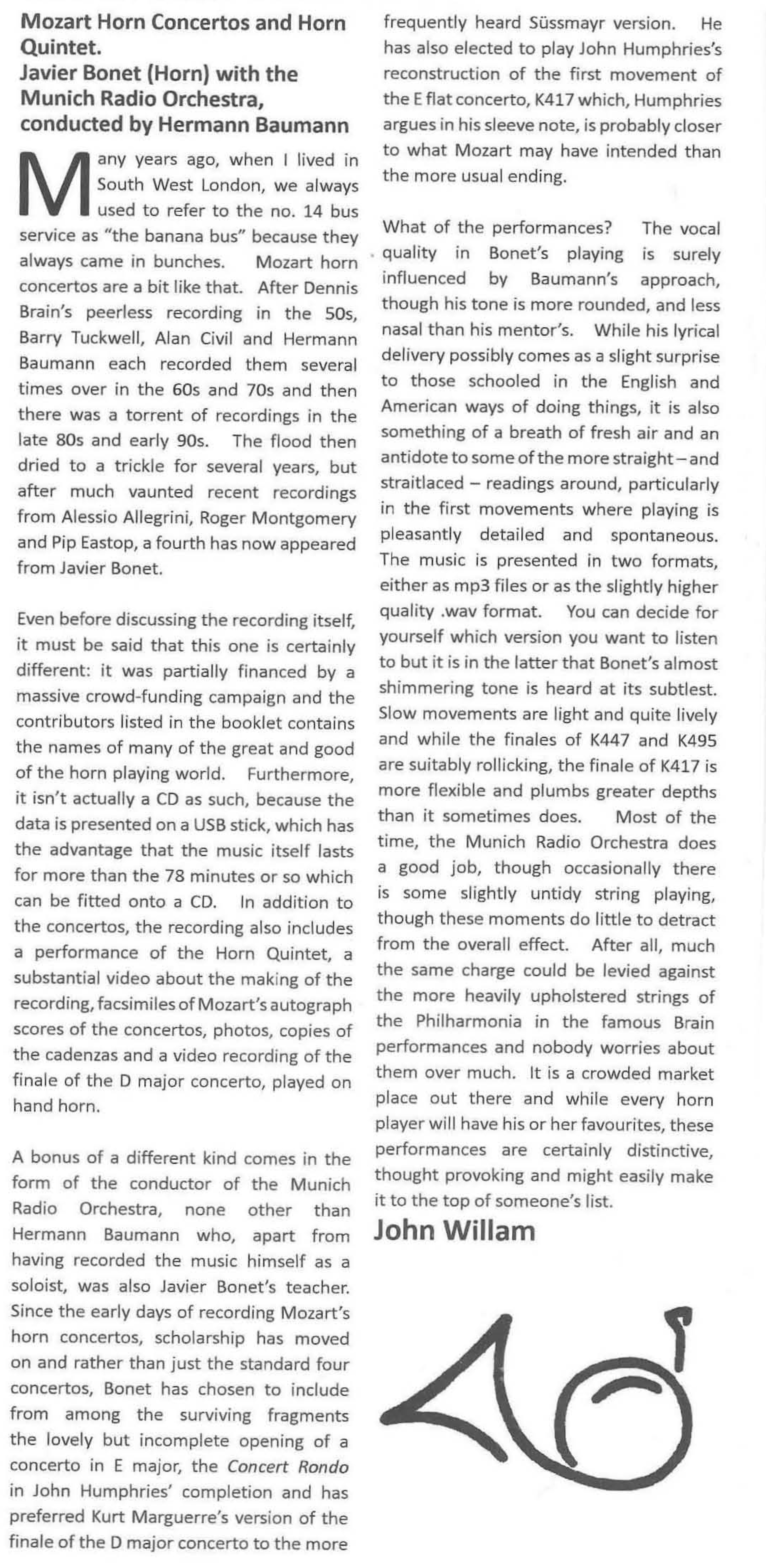


Mozart Horn Concertos and Horn Quintet: Javier Bonet (Horn) with the Munich Radio Orchestra, conducted by Hermann Baumann.
Many years ago, when I lived in South West London, we always used to refer to the no. 14 bus service as “the banana bus” because they always came in bunches.    Mozart horn concertos are a bit like that.   After Dennis Brain’s peerless recording in the 50s, Barry Tuckwell, Alan Civil and Hermann Baumann each recorded them several times over in the 60s and 70s and then there was a torrent of recordings in the late 80s and early 90s.   The flood then dried to a trickle for several years, but after much vaunted recent recordings from Alessio Allegrini, Roger Montgomery and Pip Eastop, a fourth has now appeared from Javier Bonet.
Even before discussing the recording itself, it must be said that this one is certainly different: it was partially financed by a massive crowd-funding campaign and the contributors listed in the booklet contains the names of many of the great and good of the horn playing world.    Furthermore, it isn’t actually a CD as such, because the data is presented on a USB stick, which has the advantage that the music itself lasts for more than the 78 minutes or so which can be fitted onto a CD.   In addition to the concertos, the recording also includes a performance of the Horn Quintet, a substantial video about the making of the recording, facsimiles of Mozart’s autograph scores of the concertos, photos, copies of the cadenzas and a video recording of the finale of the D major concerto, played on hand horn.
A bonus of a different kind comes in the form of the conductor of the Munich Radio Orchestra, none other than Hermann Baumann who, apart from having recorded the music himself as a soloist, was also Javier Bonet’s teacher.    Since the early days of recording Mozart’s horn concertos, scholarship has moved on and rather than just the standard four concertos, Bonet has chosen to include from among the surviving fragments the lovely but incomplete opening of a concerto in E major, the Concert Rondo in John Humphries’ completion and has preferred Kurt Marguerre’s version of the finale of the D major concerto to the more frequently heard Süssmayr version.   He has also elected to play John Humphries’s reconstruction of the first movement of the E flat concerto, K417 which, Humphries argues in his sleeve note, is probably closer to what Mozart may have intended than the more usual ending.
What of the performances?    The vocal quality in Bonet’s playing is surely influenced by Baumann’s approach, though his tone is more rounded, and less nasal than his mentor’s.    While his lyrical delivery possibly comes as a slight surprise to those schooled in the English and American ways of doing things, it is also something of a breath of fresh air and an antidote to some of the more straight – and straitlaced – readings around, particularly in the first movements where playing is pleasantly detailed and spontaneous.    The music is presented in two formats, either as mp3 files or as the slightly higher quality .wav format.    You can decide for yourself which version you want to listen to but it is in the latter that Bonet’s almost shimmering tone is heard at its subtlest.   Slow movements are light and quite lively and while the finales of K447 and K495 are suitably rollicking, the finale of K417 is more flexible and plumbs greater depths than it sometimes does.    Most of the time, the Munich Radio Orchestra does a good job, though occasionally there is some slightly untidy string playing, though these moments do little to detract from the overall effect.   After all, much the same charge could be levied against the more heavily upholstered strings of the Philharmonia in the famous Brain performances and nobody worries about them over much.  It is a crowded market place out there and while every horn player will have his or her favourites, these performances are certainly distinctive, thought provoking and might easily make it to the top of someone’s list.

John Willam

Saturday, 28 November 2015

Fragment KV 494a in E Major


The manuscripts which Constanze sold to André included another horn concerto fragment in E major on paper which suggests that it dates from 1785 or early 1786.   It appears from the fully-scored orchestral exposition that Mozart intended it to be the most ambitious of his horn concertos, but the orchestration fizzles out a few bars after the soloist comes in, and a few bars later the solo part stops in the middle of a phrase.   It is possible that Mozart continued the solo line on another sheet of paper which is now lost, but André had no use for so incomplete a work, and did not publish it.   It was also unfamiliar to Leutgeb when Constanze showed it to him.

Los manuscritos que Constanze vendió a André incluyen otro fragmento  de concierto para trompa en Mi Mayor, en un tipo de papel que se cree datado en 1785 o inicios de 1786. Parece ya desde la orquestación totalmente acabada en la exposición que Mozart pretendía que fuera el más ambicioso de sus conciertos para trompa. Por desgracia la orquestación se interrumpe unos cuantos compases después de la entrada del solista y unos cuantos compases más allá la parte de trompa se detiene en el medio de una frase. Es posible que Mozart continuara la parte del solista en otro pliego de papel que ahora está perdido, pero André no hizo uso de una obra tan incompleta y no fue publicada. También era desconocido para Leutgeb cuando Constanze se lo mostró.

Das von Constanze an André verkaufte Manuskript enthielt auch das Fragment eines anderen Hornkonzertes in E-Dur auf einem Papier, das vermuten lässt, es sei von 1785 oder Anfang 1786. Die voll ausgearbeitete Partitur der Orchestereinleitung zeigt, dass Mozart damit das ehrgeizigste seiner Hornkonzerte vorhatte, aber die Orchestrierung läuft nach einigen Takten des Soloparts aus, und einige Takte später hört die Solostimme mitten in einer Phrase auf. Möglicherweise schrieb Mozart die Solostimme auf einem anderen Blatt weiter, das jetzt verloren ist, aber André hatte keine Verwendung für ein so unvollständiges Werk und veröffentlichte es nicht. Es war auch Leutgeb unbekannt, als Constanze es ihm zeigte. 

Les manuscrits que Constanze avait vendus à André comprennent un autre fragment de concerto pour cor en mi majeur, sur un type de papier que l'on croit daté de 1785 ou début 1786. Il semble, par  l'orchestration de l'exposition, qu´il était destiné à être le plus ambitieux des concertos de cor. Malheureusement l´orchestration est interrompue rapidement après l'entrée du soliste, et la partition s´arrête ensuite en plein milieu d´une phrase peu après l'entrée du cor. Peut-être que Mozart continua la partie solo sur une autre feuille qui est désormais perdue!  Dans tous les cas André n´a pas pu utiliser une œuvre si incomplète et elle n'a donc jamais été publiée. Ce concerto était également inconnu de Leutgeb quand Constanze le lui montra.