Our recording continues to receive good reviews. This time the British Horn Magazine published by the British Horn Society!
Nuestra grabación continúa recibiendo buenas críticas. ¡Esta vez en el British Horn Magazine editado por la British Horn Society!
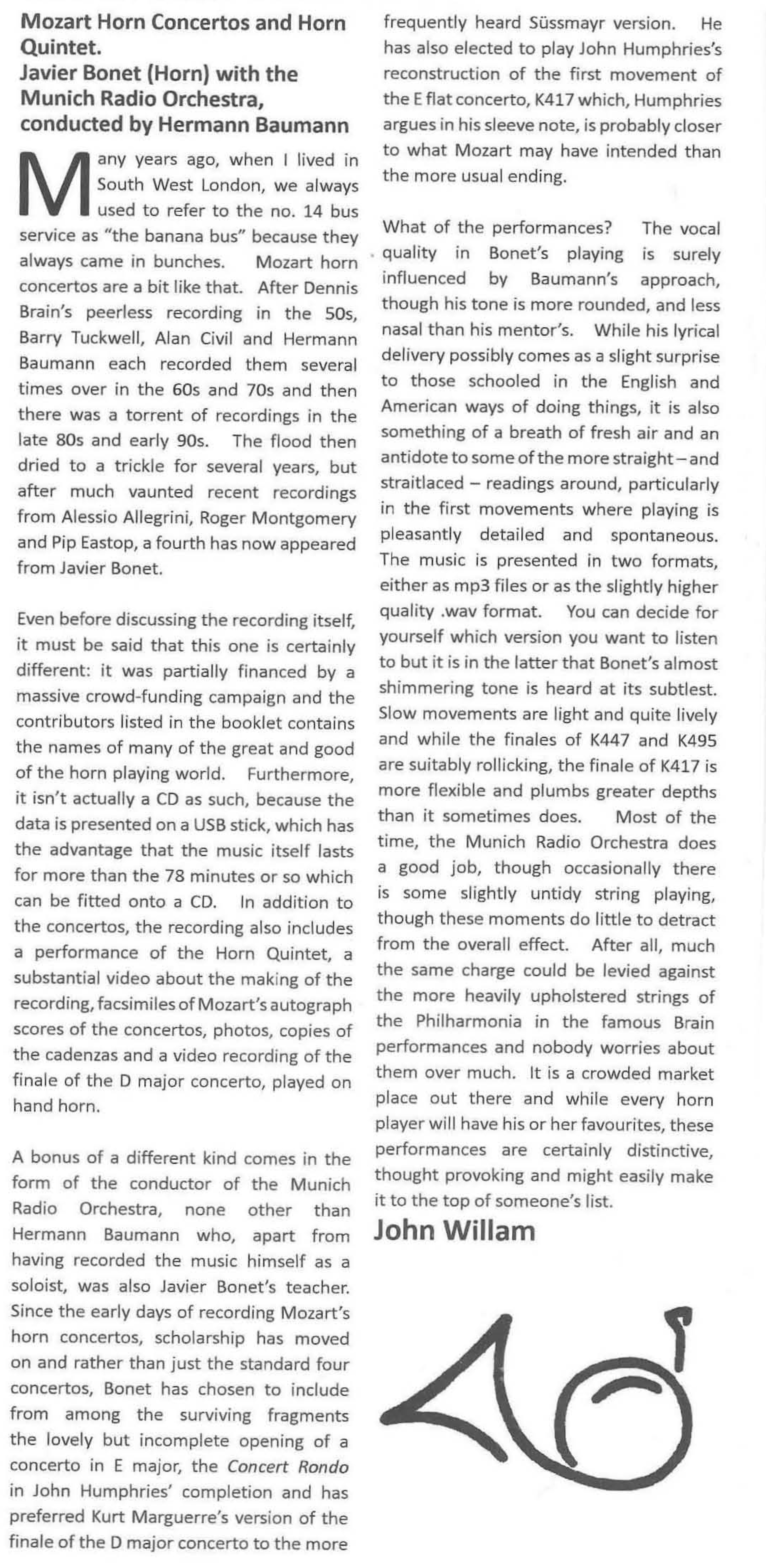
Mozart
Horn Concertos and Horn Quintet: Javier Bonet (Horn) with the Munich Radio
Orchestra, conducted by Hermann Baumann.
Many years ago, when I lived in South West
London, we always used to refer to the no. 14 bus service as “the banana bus”
because they always came in bunches.
Mozart horn concertos are a bit like that. After Dennis Brain’s peerless recording in
the 50s, Barry Tuckwell, Alan Civil and Hermann Baumann each recorded them
several times over in the 60s and 70s and then there was a torrent of
recordings in the late 80s and early 90s.
The flood then dried to a trickle for several years, but after much
vaunted recent recordings from Alessio Allegrini, Roger Montgomery and Pip
Eastop, a fourth has now appeared from Javier Bonet.
Even before discussing the recording
itself, it must be said that this one is certainly different: it was partially
financed by a massive crowd-funding campaign and the contributors listed in the
booklet contains the names of many of the great and good of the horn playing
world. Furthermore, it isn’t actually a CD as such,
because the data is presented on a USB stick, which has the advantage that the
music itself lasts for more than the 78 minutes or so which can be fitted onto
a CD. In addition to the concertos, the
recording also includes a performance of the Horn Quintet, a substantial video
about the making of the recording, facsimiles of Mozart’s autograph scores of
the concertos, photos, copies of the cadenzas and a video recording of the
finale of the D major concerto, played on hand horn.
A bonus of a different kind comes in the
form of the conductor of the Munich Radio Orchestra, none other than Hermann
Baumann who, apart from having recorded the music himself as a soloist, was
also Javier Bonet’s teacher. Since the
early days of recording Mozart’s horn concertos, scholarship has moved on and
rather than just the standard four concertos, Bonet has chosen to include from
among the surviving fragments the lovely but incomplete opening of a concerto
in E major, the Concert Rondo in John Humphries’ completion and has preferred
Kurt Marguerre’s version of the finale of the D major concerto to the more
frequently heard Süssmayr version. He
has also elected to play John Humphries’s reconstruction of the first movement
of the E flat concerto, K417 which, Humphries argues in his sleeve note, is
probably closer to what Mozart may have intended than the more usual ending.
What of the performances? The vocal quality in Bonet’s playing is
surely influenced by Baumann’s approach, though his tone is more rounded, and
less nasal than his mentor’s. While his
lyrical delivery possibly comes as a slight surprise to those schooled in the
English and American ways of doing things, it is also something of a breath of
fresh air and an antidote to some of the more straight – and straitlaced –
readings around, particularly in the first movements where playing is
pleasantly detailed and spontaneous.
The music is presented in two formats, either as mp3 files or as the
slightly higher quality .wav format.
You can decide for yourself which version you want to listen to but it
is in the latter that Bonet’s almost shimmering tone is heard at its
subtlest. Slow movements are light and
quite lively and while the finales of K447 and K495 are suitably rollicking,
the finale of K417 is more flexible and plumbs greater depths than it sometimes
does. Most of the time, the Munich
Radio Orchestra does a good job, though occasionally there is some slightly
untidy string playing, though these moments do little to detract from the
overall effect. After all, much the
same charge could be levied against the more heavily upholstered strings of the
Philharmonia in the famous Brain performances and nobody worries about them
over much. It is a crowded market place
out there and while every horn player will have his or her favourites, these
performances are certainly distinctive, thought provoking and might easily make
it to the top of someone’s list.
John
Willam
